
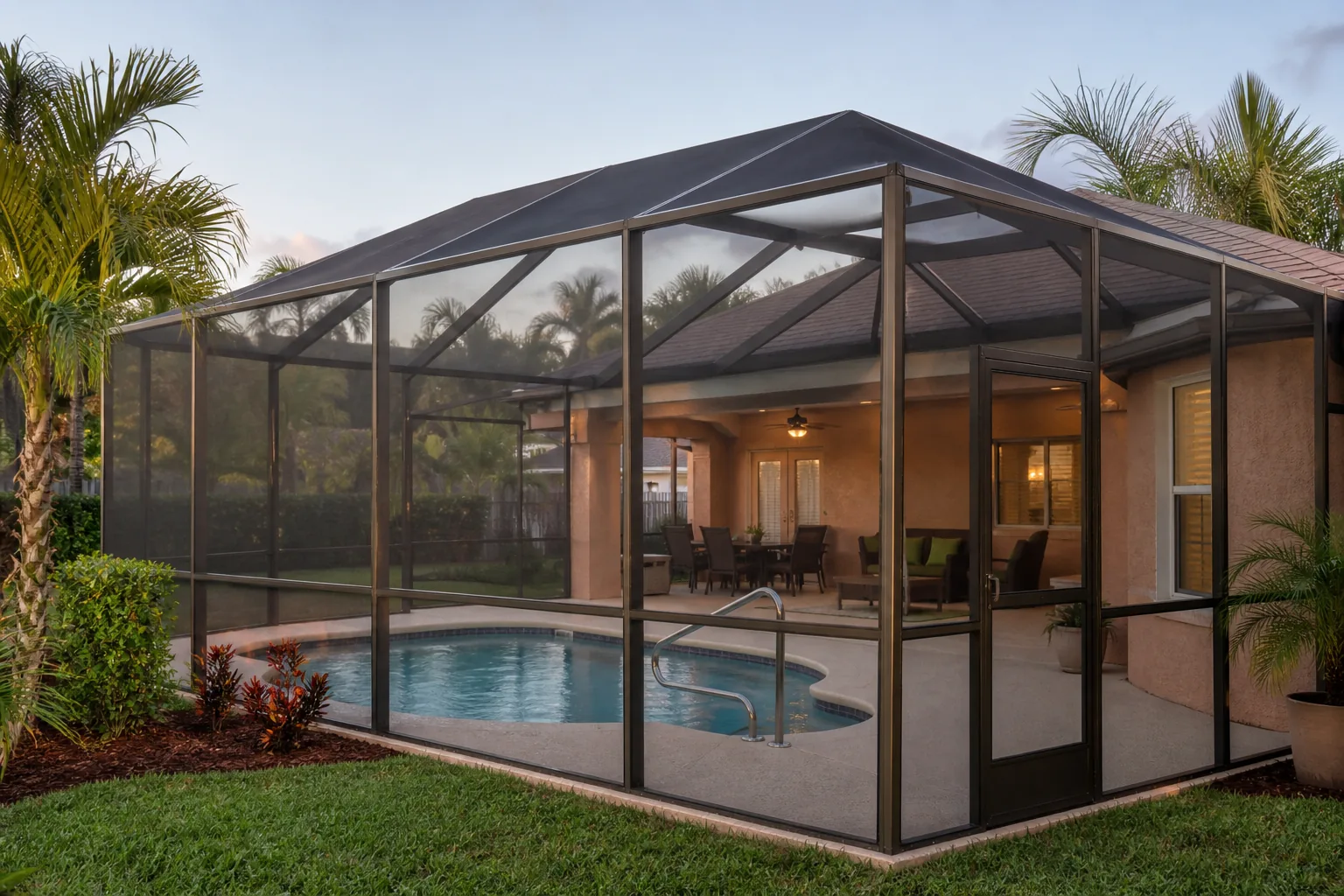
A useful property record is created before a watch or warning turns preparation into a rush. Wide photos establish the pre-storm position of an enclosure, doors, gutters, soffit, fascia, downspouts, and nearby objects. Matching post-storm photos then help an owner, contractor, or insurer distinguish an older condition from a new one.
This checklist is for documentation, not structural inspection or emergency direction. Follow evacuation, reentry, and safety instructions from public officials. Do not climb on a roof or enclosure, remove bracing, loosen fasteners, detach screen panels, or alter a system based on a generic internet checklist. Product- and structure-specific preparation belongs with the manufacturer, engineer, or qualified contractor.
Create eight fixed photo stations
Save the locations in a phone note or simple sketch. Stand on stable ground and keep each station far enough away to show context.
- Front roofline: the full gutter and fascia run, corners, downspouts, and ground discharge.
- Rear roofline or lanai connection: the way the house roof, gutter, and enclosure meet.
- Enclosure wide view: the full wall and roof geometry from the yard.
- Opposite enclosure corner: a second angle that shows depth and alignment.
- Door and threshold: hinges, latch, closer, bottom edge, deck, and surrounding frame.
- Equipment and access path: pool equipment, gates, walkways, and the route a repair crew would use.
- Large nearby objects: furniture, grills, planters, tree limbs, and other items that could contact the structure.
- Interior deck view: enclosure panels, roof panels, doors, and drainage interfaces from a safe central point.
Add close-ups only from safe reach
- Torn, loose, brittle, or previously patched screen.
- Loose spline or a panel edge that has begun to pull away.
- Bent, separated, corroded, or previously repaired visible framing.
- Door alignment, latch engagement, and closer attachment.
- Gutter joints, outlets, downspout straps, end caps, and visible fasteners.
- Loose or missing soffit, separated fascia covering, and stains around the eave.
- Existing cracks, displaced deck material, or contact between vegetation and the enclosure.
Include a date, station number, and a plain description. Avoid conclusions such as “structurally sound” when the photo only establishes appearance.
Keep documentation separate from storm preparation
Ready.gov advises bringing loose, lightweight outdoor objects inside or securing items that cannot safely be brought indoors. The same federal guidance emphasizes following local instructions, knowing evacuation routes, and staying away from unsafe buildings and floodwater. Use official guidance for people and property safety; use this article only to organize exterior records.
If a pool-enclosure or aluminum-system manufacturer supplied a storm procedure, keep that document with the property record. If the structure has engineered instructions, follow those instructions. When no project-specific instruction is available, ask the appropriate qualified professional well before a storm threatens rather than improvising a change under time pressure.
After the storm, wait for safe access
Do not return until authorities allow it. From stable ground, first look for downed power lines, standing water, gas odor, displaced structures, sharp debris, hanging materials, and other immediate hazards. Keep people and pets away from the area and contact the appropriate emergency service or qualified professional.
If the area is safe to photograph, repeat the eight stations before cleanup or temporary repair. Do not touch a leaning frame, hanging gutter, energized material, unstable soffit, or sharp screen wire to improve a picture.
Use a before-and-after comparison table
| Station | Before | After | Action |
|---|---|---|---|
| Location and view | Date and file name | Matching date and file name | None, monitor, restrict access, or request review |
| Visible change | Existing condition | New movement, opening, tear, stain, or debris contact | Describe without diagnosing |
| Temporary work | Not applicable | Who authorized it, time, materials, and photos | Preserve receipts and instructions |
Prepare the contractor and insurance handoff
- Property address, contact information, and the safest access point.
- Before-and-after files in matching station order.
- Approximate time the condition was first observed.
- Whether water entry, electrical contact, loose material, or restricted access is present.
- Original permits, engineering, product information, prior repair records, and warranties when available.
- Insurance claim instructions and any required authorization before permanent work.
For regulated construction work, Florida's Department of Business and Professional Regulation provides a license-verification portal and explains how to check both the individual contractor and the business entity. CamoKrew lists Florida Certified Building Contractor license CBC1268676; verify current status directly with DBPR rather than relying on a screenshot or marketing page.
Helpful public references
- FEMA/Ready.gov: How to Prepare for a Hurricane — wind, water, outdoor-item, evacuation, and post-storm safety context.
- Ready.gov Hurricane Hazard Information Sheet — official preparation, shelter, reentry, documentation, and professional-inspection guidance.
- Florida DBPR: How to Verify a License — current license-search process.
- Florida DBPR construction-industry business information — checking the qualifying contractor and business entity.